How Much Does It Cost to Remove Tree Roots From a Drain?
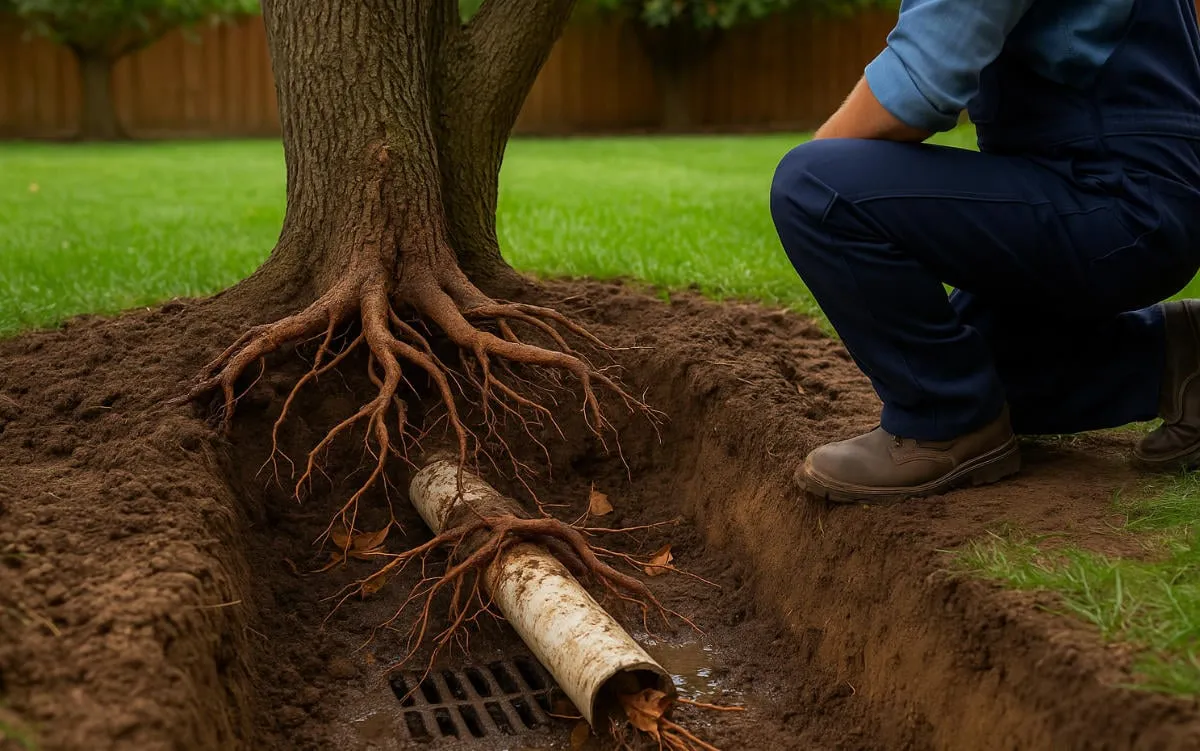
Cutting roots out of a drain is one price; stopping them coming back is another. What drives the cost of root removal, what a proper quote should separate out, and when the tree's owner may be liable.
The cost of removing tree roots from a drain depends mainly on how far the roots have spread along the pipe and how many joints they have got into. A single root mass at one joint near an access point is a short job. Roots running through several joints of an old clay drain, or a pipe that has cracked around them, is a much bigger one. The other thing that decides your total is whether you only cut the roots out or also seal the pipe so they cannot get back in, and those are two separate prices that a good quote keeps apart.
What does root removal actually involve?
Roots are cut out of the pipe from an inspection chamber using a rotating cutting head, driven either on rods or by a high-pressure water jet. The debris is then flushed through and the pipe is checked on camera to confirm it is clear.
The camera part is not optional padding. Roots get into drains through joints and cracks, so the only way to know how much damage they have done is to look. A root that has lifted a joint or split a clay pipe will be back within months unless the defect is dealt with. Our root cutting service page describes the equipment and the process in more detail.
What decides the cost?
Four things drive the price: the extent of the root growth, access to the affected length, the size and material of the pipe, and when the work is done. Most of the variation between jobs comes from the first two.
Extent. Fine hair roots at one joint can be cleared quickly. A dense mass that fills the bore, or roots at every joint along a run, takes much longer and wears cutting heads out. Until the drain has been seen on camera, nobody can honestly tell you which you have.
Access. Cutting is done from a chamber or rodding point. If the affected length is close to one, the work is straightforward. If the nearest chamber is buried under a patio, or the run between chambers is long, the job takes more time and may need a new access point.
Pipe size and material. Most domestic drains in London are 100mm or 150mm, and many older properties still have the original salt-glazed clay pipes with mortar joints that roots find easy to enter. Larger diameters, and pitch fibre pipes that deform easily, need more care and different tooling.
Time band. Our rate card is split into standard hours, evenings and nights. Root ingress builds up slowly, so unless the drain is fully blocked and backing up, it is almost always a job to book in standard hours.
Why cutting alone is often not the whole bill
Cutting roots out clears the pipe, but it does not close the gap they came in through. If the defect stays open, the roots regrow, and you pay for the same visit again.
That is why the survey afterwards matters. If it shows roots through one or two joints in an otherwise sound pipe, a localised repair to seal those joints may be all that is needed. If it shows cracking, displaced joints or roots along a whole run, the longer-term options are lining the pipe or replacing the damaged section, and each of those is quoted separately once the extent is known. Our drain relining page explains how sealing a pipe from the inside works.
There are cases where repeat cutting is the reasonable choice. A drain that is structurally sound but sits beside a vigorous tree may justify a planned clean on a set interval rather than a larger repair, particularly for a landlord weighing up the cost over several years. It is a legitimate option, as long as it is chosen knowingly rather than because nobody looked.
How to tell if roots are the problem
Roots are the likely cause if a drain near a tree blocks repeatedly, drains slowly in all fittings, and clears for a while after rodding before slowing again. Only a camera survey confirms it.
Other signs include a chamber that fills and empties slowly, gurgling from gullies, and roots visible in an open chamber. Our guide on how to tell if tree roots are in your drains covers the symptoms in more depth. If you are not sure, a survey first is cheaper than a root-cutting visit that turns out to be treating the wrong problem.
Who pays when the roots come from someone else's tree?
If the pipe is yours, the cost of clearing it is initially yours, but you may be able to recover it from the tree's owner. If the affected length is a shared sewer or lateral drain, it is usually the sewerage undertaker's to deal with.
For a street tree, the owner is normally the local council, and councils have claims processes for root damage. For a neighbour's tree, the neighbour may be liable if their tree has caused the damage. In both cases, the evidence that matters is a camera survey showing where the roots enter and what damage they have done, together with the tree's position. Keep the footage and the written report.
If the roots are in a pipe that also serves your neighbours before it reaches the public sewer, that length has very probably been the sewerage undertaker's responsibility since 2011. Report it to Thames Water before paying anyone to cut it.
What a fair root removal quote should show
A fair quote separates the survey, the root cutting and any repair, so you can see what each costs and decide on them one at a time. If a quote bundles all three into one figure before anyone has looked inside the pipe, ask how the repair was sized.
Ask whether the price is fixed or charged by time, whether VAT is included, whether the post-cut camera check is part of the price, and whether you receive the footage. Then, if a repair is recommended, you have what you need to compare it against another contractor's quote on the same scope. When you are ready, send us the details and we will tell you which rate applies before we attend.
Frequently asked questions
Do tree roots always come back after cutting?
If the joint or crack they entered through is left open, they usually do, because the tree is still drawn to the water and nutrients in the pipe. How quickly depends on the species and the size of the gap. Sealing the defect after cutting is what stops the cycle; cutting on its own buys time.
Can I use chemical root killer instead of paying for root cutting?
Root treatments can slow regrowth in some cases, but they do not remove a root mass that is already blocking the pipe, and they do nothing to close the defect the roots came through. For a drain that is already slow or blocked, mechanical cutting and a camera check is the reliable route.
Will my home insurance pay for root damage to a drain?
Some buildings policies cover accidental damage to underground pipes, and some exclude gradual damage such as root ingress. Check the wording and speak to your insurer before booking a repair. Either way, a camera survey report showing the cause and extent of the damage is what an insurer will ask for.